
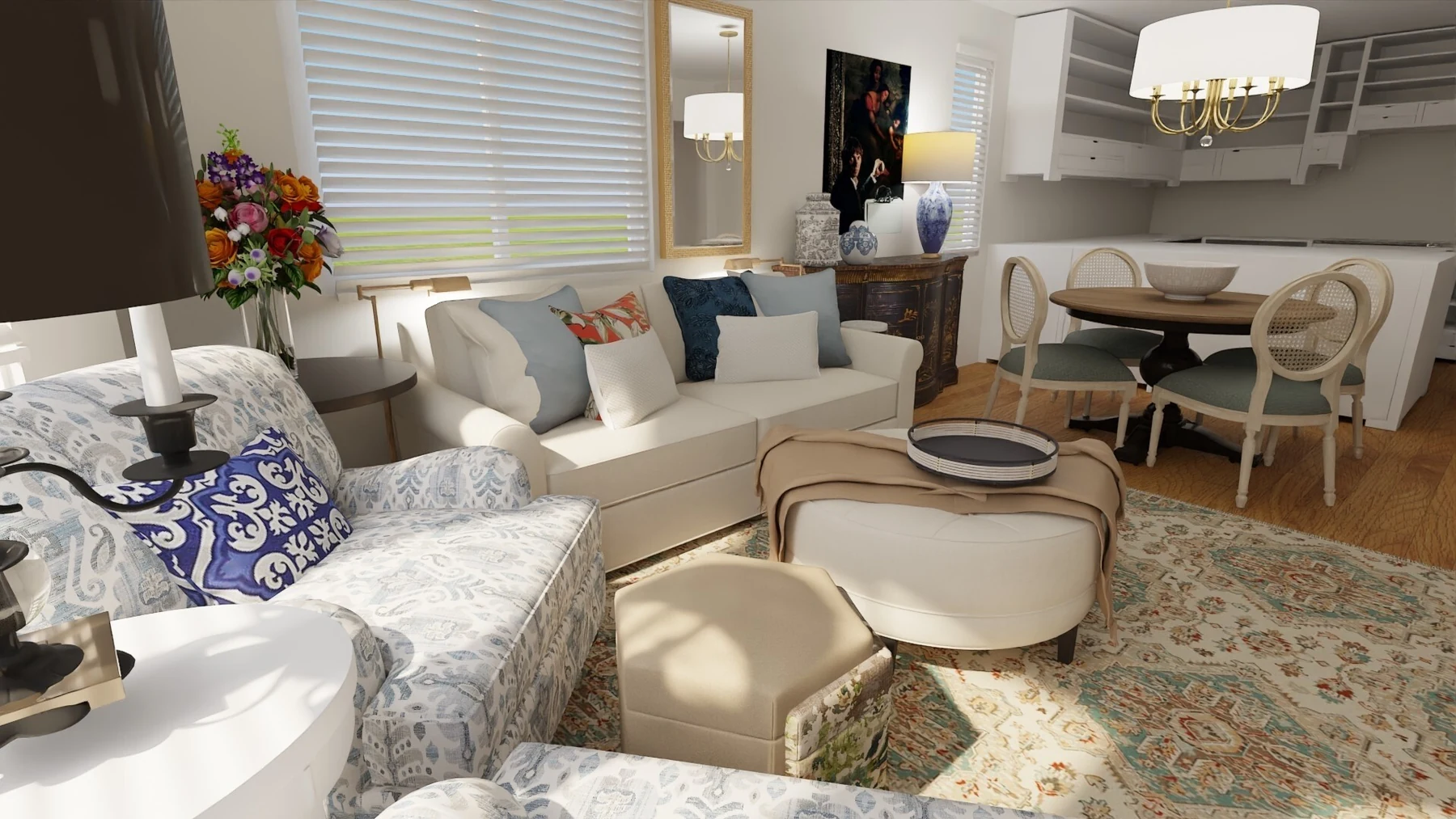
Sometimes the most effective change to a living room is not a different piece of furniture. It is recognizing which pieces are supposed to have a relationship with one another.
I often see furniture pushed around the perimeter so every item appears to belong primarily to the nearest wall. The center remains strangely empty. Tables are too distant to be useful, chairs feel isolated and the arrangement doesn't seem to suggest any particular way for people to gather.
The solution is not a rule that every sofa must sit a particular number of inches away from a wall. Some rooms need more space; others need less. What matters is the relationships among the pieces.
Two chairs placed in unrelated parts of the room may not read as a pair at all. Bring them into a more coherent distance and turn them slightly toward one another, and they begin to form a unit. The same applies to a sofa, coffee table, lamps and adjacent seats.
One quick way to look at a living room is to ignore decoration for a moment and notice the empty areas between pieces. Are those distances establishing useful groupings, or has every object been given roughly the same amount of breathing room regardless of its function? Equal spacing can create a collection of isolated objects rather than places where activities can happen.
Then look at which pieces belong to one another. A sofa might visually relate mainly to the wall behind it, even though the intended conversation is with chairs across the room. Two chairs may be pointed toward different parts of the space when a slight rotation would make them feel like a pair. A table can look correctly sized and still be too far away to serve the people sitting near it.
There is no universal distance to prescribe. The useful test is whether the arrangement makes its relationships evident and physically workable. Sometimes the shift is slight, but the reason for moving something should be clear: to connect it to the activity and other furnishings it is meant to support.
A useful first test is to compare the distances. If everything is approximately equally spaced from everything else, the room may have no meaningful groupings. Ask which pieces are intended to support the same activity. Then see whether their placement makes that relationship visible and usable.
Often a modest adjustment in location or angle is enough to change how the whole arrangement makes sense.