
When someone tells me they want a home that reminds them of a place they love, I usually ask about moments rather than destinations.
One client wanted a sense of the Parisian luxury she remembered from repeated travels. As she described particular interiors, the same elements returned: a certain blue, black-painted furnishings against raw wood, white and brass, chinoiserie pottery, and unexpectedly, black lampshades. What mattered was not reproducing an official Parisian style. It was understanding the particular relationships of finish, color and atmosphere that had remained with her.
Cultural heritage asks for a different kind of attention. In one project, cultural heritage was meaningful to the family alongside their present everyday life. I wanted colors, patterns, artwork and references to arise from lived memories and meaningful cultural experience, not a generalized decorative stereotype.
Collected travel objects create another challenge. A household may own textiles, vessels and artwork from entirely different places. Some pieces share colors or motifs; others have no obvious relationship at all. They do not need to be forced into uniformity.
The Paris project reminded me how quickly a destination label can flatten a very particular memory. A person might say 'Parisian luxury' and believe they have given the designer a clear image. But that phrase could describe countless different spaces. Rather than asking for an abstract definition, I wanted the client to return to the hotels she remembered and the details that kept appearing in her descriptions. The painted black surfaces next to raw wood were especially important. They created a direct material contradiction that felt familiar to her, while the blue, brass, ceramics and dark lampshades helped complete the remembered atmosphere.
I expected decorative pillow patterns to have a larger role in translating the inspiration. What emerged instead was the relationship between neighboring pieces: their finishes, how worked and unworked surfaces met, and the way she recognized certain combinations. That changed how I understood what the reference was really asking for. The design could be specific to her memory rather than merely recognizable as a style.
That project raised a different responsibility. A family connection to Mexican heritage is not simply an aesthetic vacation reference. I looked toward colors, patterns, art and the everyday visual world tied to what the client knew and remembered: the presence of objects and imagery in family life, the kinds of things encountered in markets, and connections across generations. The objective was not to produce an imitation of a cultural interior. The family's current life in the United States belonged in the home just as much as the places and histories they wanted to remember. That required personal dialogue and restraint about what any one motif could claim to represent.
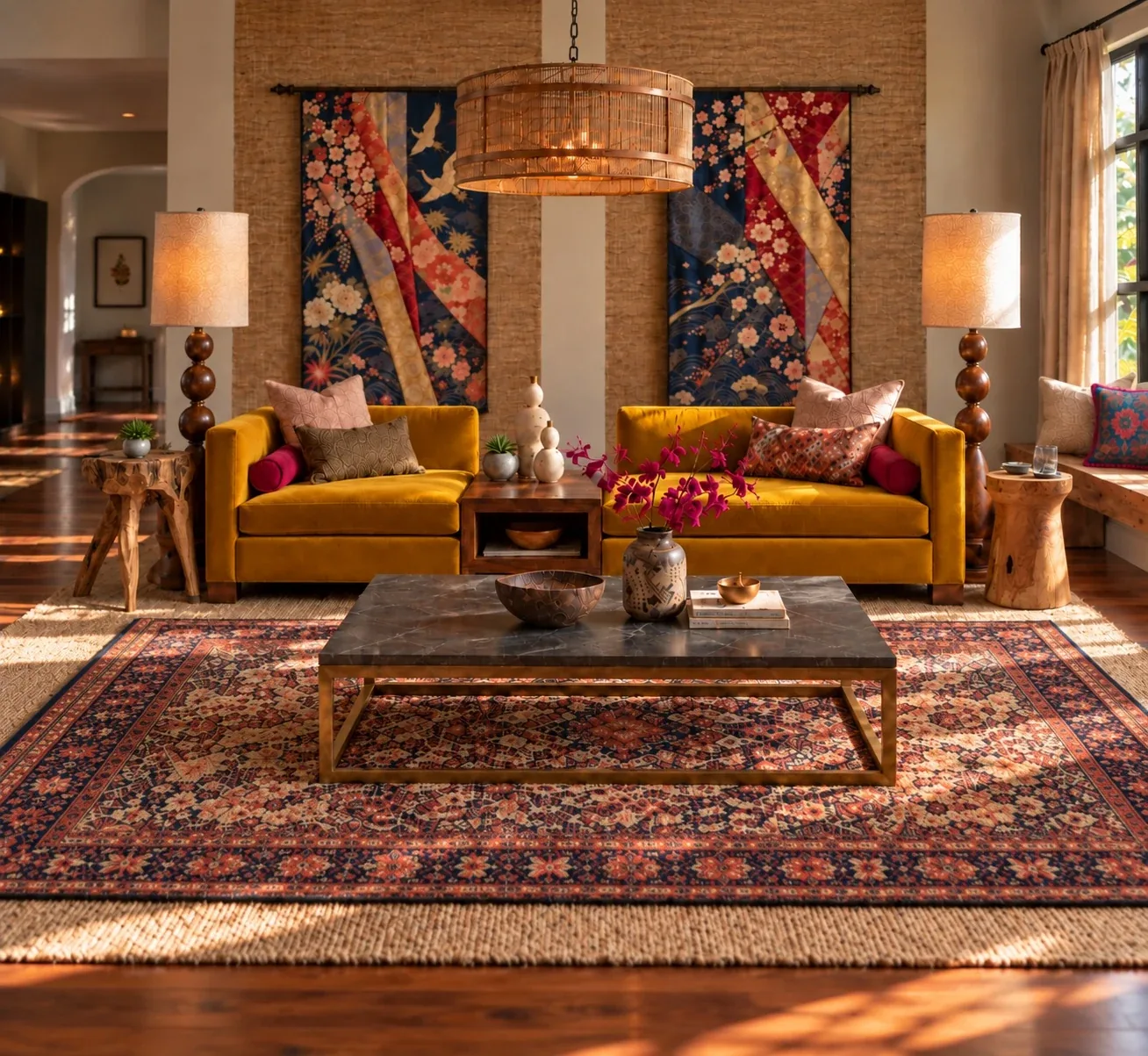
A third form of travel connection appears when a person brings objects home over many years. The collection may contain pieces from different countries with almost no consistent style. The first step need not be forcing them into coordination. I may look for small relationships in color, a floral detail that appears in more than one textile tradition, or recurring pottery textures. But those commonalities aren't compulsory.
Often, larger furnishings can be calmer in color and less varied in wood tone than I might otherwise choose. That is a deliberate redistribution of complexity, not a rejection of color. The room's broad surfaces offer stability so that the smaller, meaningful objects can continue to be individually appreciated. In a different personality's home, a strong color backdrop and exuberant eclecticism may be preferable. What determines the decision is the person, not a universal rule about collections.
A museum analogy helps explain only part of the idea. In a gallery, restraint around an artwork can leave room to appreciate it. At home, I still want a room that feels inhabited, comfortable and personally connected rather than an impersonal exhibition. The surrounding environment has to participate in the person's life, not merely disappear behind the collection.
The aim is to make room for the places a person carries within them, without reducing those places to an aesthetic formula.